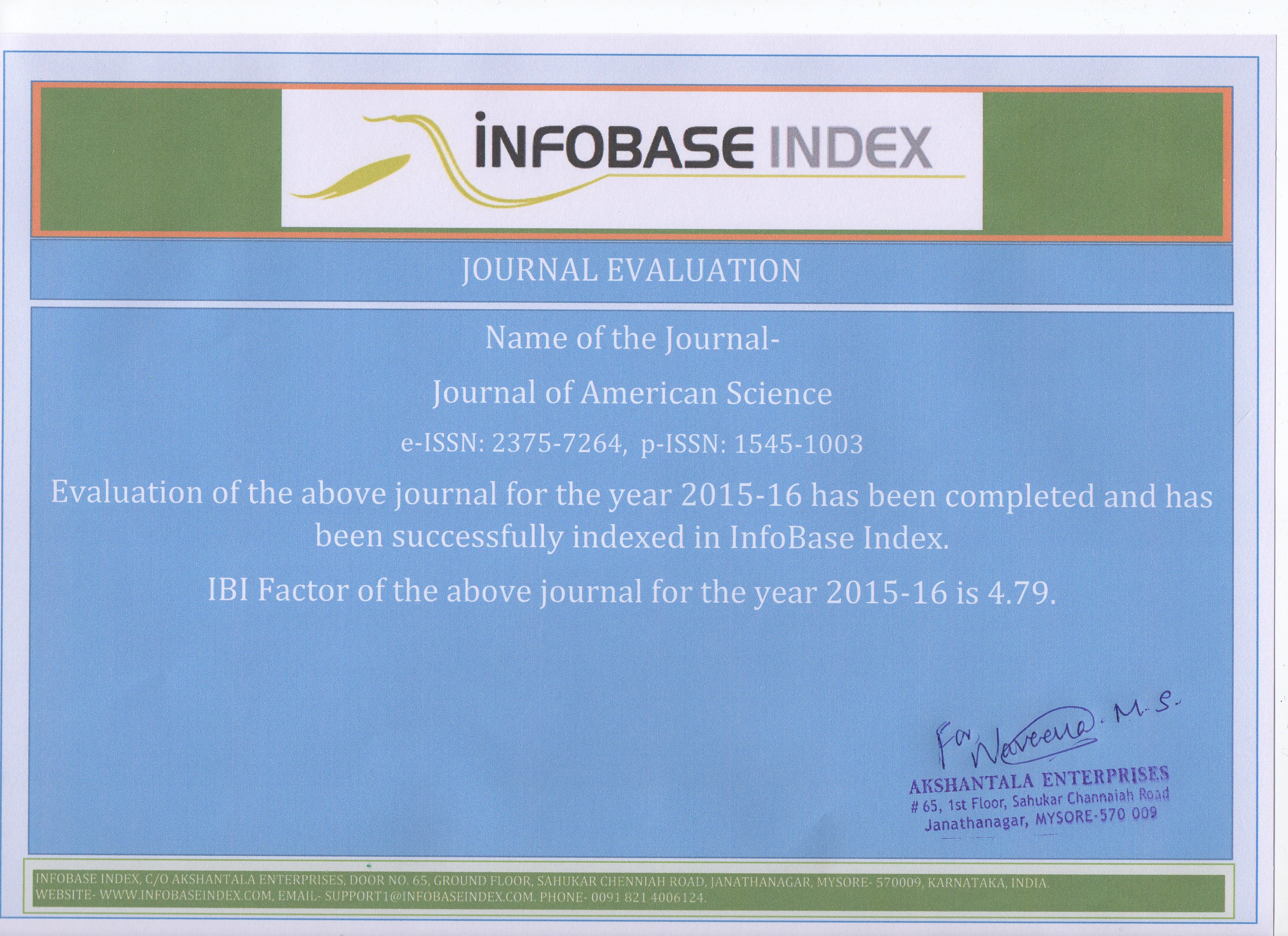
|
The Journal of American Science
(J Am Sci)
ISSN 1545-1003 (print); ISSN 2375-7264 (online),
doi prefix: 10.7537, Monthly
Volume 22, Issue 8, Cumulated
No. 222, August 25, 2026
Cover (pdf),
Cover,
Introduction,
Contents,
Call
for Papers
The following manuscripts are presented as online first for
peer-review, starting from August 2, 2026.
All comments
are welcome:
editor@sciencepub.net;
americansciencej@gmail.com,
or contact with author(s) directly.
You can use the message in end of the article abstract to
cite it.
To get Microsoft Documents: After you open the
"Full Text" for each article, change the last 3 characters of
the web address from .pdf to .doc
Welcome to send
your manuscript(s) to:
americansciencej@gmail.com.
Marsland Press, 310 W 18th
Street, New York, NY 10011, USA.
718-404-5362; 347-321-7172
CONTENTS
|
No.
|
Titles / Authors
|
Full
Text
|
No.
|
|
1
|
PARAMETRIC INVESTIGATION OF THE DYNAMIC
AMPLIFICATION FACTOR OF EULER–BERNOULLI BEAMS ON VARIABLE
ELASTIC FOUNDATIONS UNDER MOVING DISTRIBUTED LOADS
1*I.A Idowu, 2R.A
Mustapha, 1A.A Abdurasid, 1T.A Abozos, and
1J.A Ademosu
1Department of Mathematical
Sciences, Lagos State University of Science and Technology,
Ikorodu, Lagos
3Department of Mathematics, Lagos
State University, Ojo.
E-mail:
idlaspotech@yahoo.com,
idowu.ia@lasustech.edu.ng
Abstract:
The dynamic behavior of beams subjected to moving loads is an
important consideration in the design of transportation and
civil engineering structures, including railway tracks, highway
bridges, crane girders, and conveyor systems. This study
presents a parametric investigation of the dynamic amplification
factor (DAF) of an elastically supported Euler–Bernoulli beam
resting on a variable elastic foundation under partially
distributed moving loads. The beam–foundation interaction is
modelled using a spatially varying elastic foundation, while the
moving load is represented as a finite-length distributed load
travelling at constant velocity. The governing partial
differential equation is formulated based on Euler–Bernoulli
beam theory and solved using an analytical modal superposition
approach complemented by numerical simulations for validation. A
comprehensive parametric study is conducted to evaluate the
effects of foundation stiffness variation, moving load velocity,
load distribution length, beam flexural rigidity, damping ratio,
and support stiffness on the dynamic amplification factor and
maximum beam deflection. Particular attention is given to
identifying critical loading conditions associated with
resonance and dynamic instability. The results demonstrate that
increasing foundation stiffness and damping significantly
reduces the dynamic amplification factor, whereas higher load
velocities and longer load distributions may substantially
increase the beam response near critical speeds. The findings
provide valuable insights into the dynamic behavior of
beam–foundation systems and offer practical guidance for the
design and optimization of engineering structures subjected to
moving distributed loads.
[I.A Idowu, R.A Mustapha, A.A
Abdurasid, T.A Abozos, and J.A Ademosu
.
PARAMETRIC INVESTIGATION OF THE
DYNAMIC AMPLIFICATION FACTOR OF EULER–BERNOULLI BEAMS ON
VARIABLE ELASTIC FOUNDATIONS UNDER MOVING DISTRIBUTED LOADS.
J Am Sci
2026;22(8):1-15]. ISSN 1545-1003 (print); ISSN 2375-7264
(online).
http://www.jofamericanscience.org.
01. doi:10.7537/marsjas220826.01
Keywords: Euler–Bernoulli beam; Dynamic amplification factor
(DAF); Variable elastic foundation; Moving distributed load |
Full Text |
1
|
|
2
|
ALL IS THE STABLE
NUMBER
Chun-Xuan. Jiang
P. O. Box142-206 ,
Beijing 100854, P. R. China
j555j556@163.com
Abstract:
Why we have five
fingers. We suggest two principles: (1) the prime principle and
(2) the symmetric principle. We prove that 1, 3, 5, 7, 11, 23,
47, and 2, 4, 6, 10, 14, 22, 46, 94 are the most stable numbers,
which are the basic building-blocks in clusters and
nanostructures. The prime principle is the mathematical
foundations for clusters and nanostructures . All is the stable
number.
[Chun-Xuan. Jiang.
ALL IS THE STABLE NUMBER. J Am Sci 2026;22(8):16-20].
ISSN 1545-1003 (print); ISSN 2375-7264 (online).
http://www.jofamericanscience.org.
02. doi:10.7537/marsjas220826.02
Keywords: five fingers; prime principle; symmetric principle;
stable numbers; mathematical foundations; clusters and
nanostructures |
Full Text |
2
|
|
3
|
Tailoring the
Interfacial Reinforcement Efficiency of Polyvinyl Alcohol Matrix
using Refractory Ceramic Nano-fillers
1 Dr
Jyotsna Chauhan, 2akansha mehto, 3Shaswat
Chauhan
1Professor
in RGPV, 2Research scholar ,3 BITS Pilani
GOA
ABSTRACT:
This paper explores polymeric nanocomposites based on
refractory ceramic oxides with
special emphasis
on polyvinyl
alcohol (PVA)
as the
host matrix.
The aim of the
study
is to
synthesizing nanoparticles and their
nanocomposite membranes for improving the
structural, optical and morphological characteristics of
nanocomposite membrane. This establishes the foundation by
giving an overview of refractory materials and highlighting
their important for withstanding high temperatures in a
variety of
industrial
processes along with
the literature
survey. The
area of focus is the incorporation of nanoparticles into a
polymer matrix, which provides improved chemical and physical
properties. The use of PVA as a host matrix is justified by
highlighting its remarkable properties, including mechanical
strength, flexibility, and film-forming ability. A thorough
explanation of PVA's hydrophilic properties and its wide range
of uses from food packaging to sensors, supercapacitors,
catalysts, and more is then discussed.
[Dr Jyotsna Chauhan, akansha mehto, Shaswat Chauhan.
Tailoring the Interfacial Reinforcement Efficiency of Polyvinyl
Alcohol Matrix using Refractory Ceramic Nano-fillers.
J Am Sci
2026;22(8):21-30]. ISSN 1545-1003 (print); ISSN 2375-7264
(online).
http://www.jofamericanscience.org.
03. doi:10.7537/marsjas220826.03
Keywords: Tailoring; Interfacial Reinforcement Efficiency;
Polyvinyl Alcohol; Matrix; Ceramic Nano-fillers |
Full Text |
3
|
|
4
|
Markanda River (Tamil Nadu) and its future
Gangadhara Rao Irlapati
H.No.5-30-4/1, Saibabanagar, Jeedimetla, Hyderabad, India-500055
Email:
gangadhar19582058@gmail.com
Abstract:
The
Markanda River (Tamil Nadu), belongs to the country of India in
the Asian continent..
Here is an important and significant thing that
scientists should be grasped and noted by the researchers
regarding the changes in climate conditions.. Recently, due to
climate changes, water bodies like rivers, lakes, ponds,
reservoirs, barrages, dams, and glaciers etc. are drying up or
overflowing, causing many catastrophic situations. According to
the Indian Monsoon Time Scales, it is come to known that there
will be climate changes in the coming years “i.e” heavy rains
and and floods etc. will occur until about 2075, and there will
be droughts and famines until about 2150. So, based on the
studies of the Indian Monsoon Time Scale, basins and catchment
areas of the Markanda River (Tamil Nadu) will be filled with
waters in the coming years. This is just only a scientific
observation with a scientific perspective and not that these
consequences will occur and in some years it may be fulfilled
and in others it may not be fulfilled. In this study, we can
take any thing that is useful in scientific research. So
scientists, engineers, irrigators etc. can monitor the
conditions of the Markanda River (Tamil Nadu) through the
establishment and study of the Indian Monsoon Time Scale.
Through this research, we can know the future consequences of
the above Markanda River (Tamil Nadu) catchment areas and
basins. Plans can be made accordingly. So, Indian scientists can
establish the Indian Monsoon Time Scale and predict what is
going to happen in the above Markanda River (Tamil Nadu) basins
and catchment areas in the coming 50 years roughly. Now let us
know how to design and establish of Indian Monsoon Time Scale,
how to study the climate changes and how to predict the future
conditions of the above Markanda River (Tamil Nadu).
To predict the future
conditions of the Markanda River (Tamil Nadu), Indian Monsoon
Time Scale is described below for the convenience of Indian
scientists to study the precipitation includes drizzle, rain,
sleet, snow, ice pellets, graupel, and hail etc. around the
catchment areas of the Markanda River (Tamil Nadu). Indian
scientists may select and develop a suitable Monsoon Time Scale
which is used to estimate the climate conditions in the
catchment areas of the Markanda River (Tamil Nadu) as outlined
below.
[Gangadhara Rao Irlapati.
Markanda River (Tamil Nadu) and its future. J Am Sci 2026;22(8):31-106]. ISSN 1545-1003 (print); ISSN 2375-7264
(online).
http://www.jofamericanscience.org.
04. doi:10.7537/marsjas220826.04
Keywords:
Bioforecast (1965-70); A New Hypothetical Model of Cosmology
(1970-77) ; Inquisition(1977-79) ; Basics of Geoscope (1980-87)
; Basics of Monsoon Time Scales (1987-91) ; Indian Monsoon Time
Scale (1991) ; Researches on Earth and space related issues
(1991-2000) ; Numerical Weather Periodic Tables (2000-10) ;
Designs of Geoscope projects (2010-20) ; Designs of Global
Monsoon Time Scales (2020-) |
Full Text |
4
|
|
5
|
|
Full Text |
5
|
|
6
|
|
Full Text |
6
|
|
7
|
|
Full Text |
7
|
|
8
|
|
Full Text |
8
|
|
9
|
|
Full Text |
9
|
|
10
|
|
Full Text |
10
|
All
comments are welcome:
editor@americanscience.org;
americansciencej@gmail.com,
or contact with author(s) directly.
For back issues of the Journal of American Science, click here.
Emails:
editor@americanscience.org;
americansciencej@gmail.com
|